
The Leadership Map: Putting Data Behind Your Shadow
Over the last few weeks, we have been looking under the bonnet at what actually drives performance in the senior tiers of large organisations. We have talked about the internal Inner Game, the reality that roughly 80% of leaders remain stuck in a defensive posture, and how that subconscious anxiety creates a shadow that can quietly paralyse a team’s velocity.
That 80% statistic sounds incredibly high, but it has nothing to do with a lack of capability. No one gets a seat at the executive table by accident because these are exceptionally capable people. The real hitch is that the exact strategies that won you your track record are often the very things keeping you pinned to it.
The Paradox of the Overused Strength
Our professional identity is usually constructed outside-in. Early in our careers, we build a persona based on what the corporate hierarchy rewards.
If you are naturally analytical, you become the definitive expert who has all the answers. If you are highly driven, you become the powerhouse who drags projects over the finish line through sheer force of will. If you are relational, you become the reliable colleague who ensures everyone stays aligned and happy.
These are genuine assets. But when a role gets more complex, such as moving from technical execution to navigating the messy and ambiguous realities of senior management, the pressure ramps up. Under that kind of strain, our internal operating system defaults to what it knows best. We lean heavily on our favourite tool.
Viewed this way, a Reactive mindset is simply a core strength being overused because you are looking for a bit of security under pressure.
Controlling is the dark side of a massive, healthy drive for results.
Protecting is the defensive deployment of a sharp intellect to keep people at a safe distance.
Complying is the over-indexing of a genuine capacity for loyalty, turned into a shield to avoid the friction of a disagreement.
This is legacy software running on modern hardware. You are using individual, tactical strengths to solve systemic, human problems. The result is exhaustion for you, and a bottleneck for your team.
The Geography of the Map
To break out of this loop, you cannot rely on gut feel or vague self-reflection. You need hard data. This is why I use a framework called the Leadership Circle Profile (LCP).
Most psychometric tools look at personality traits. They tell you what you are, like an inventory of the parts in a car. The LCP is different. It is a 360-degree diagnostic that maps your internal assumptions against your external leadership behavior. It measures the relationship between two distinct halves of your operating system.
The lower half maps your Reactive tendencies. It highlights where your best traits get hijacked because you are trying to protect your status or your reputation. Essentially, it measures the energy you waste playing not to lose.
The upper half maps your Creative competencies. This is your leadership running at full capacity. It uses those exact same core strengths, including your drive, your intellect, and your relational capability, but flips the driver from fear to purpose. Instead of managing your own optics, you are focused on architecting the environment, scaling leadership through others, and driving systemic results.
There is hard commercial data behind this. Bob Anderson and Bill Adams’ research shows a 0.61 correlation between high Creative scores and actual business performance. In statistical terms, that means 37.6% of the total variation in an organisation's performance across sales growth, market share and profitability is driven directly by the maturity of its leadership operating system.
Vertical development allows your personality to stay exactly as it is. It is simply about shifting the power balance from the bottom of that circle to the top.
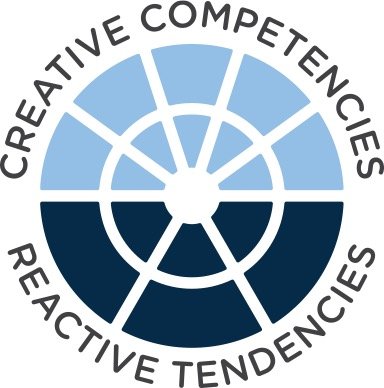
The Leadership Circle model representing Creative Competencies and Reactive Tendencies.
The Climate You Create
In the institutions I work with, I see this Shadow in action every day.
Consider a leader with a high Controlling default. They are usually working harder than anyone else to push the business forward, yet they are often the exact reason the team is sitting on their hands. Bob and Bill's data reveals a direct minus 0.64 correlation between high control and the quality of relationships within a team. In plain English, as a leader's grip tightens, team trust and collaboration collapse. You are trading collective capability for personal comfort. When nothing moves without your explicit sign off, people simply stop bringing new ideas to the table. Why bother? Innovation is dead on arrival when the room is stripped of the autonomy to think.
Then there is the Perfecting shadow. This is where experimentation goes to die. When a leader is terrified of mistakes, the team becomes paralysed. No one wants to be the one who sends over a 95% correct report or a rough prototype. The result is a massive waste of energy on technical minutiae while the velocity of the project slows to a crawl. You cannot ask a team to fail fast or be agile in an environment where anything less than a flawless result is seen as a career risk.
This is the link back to the Collective Ceiling. You cannot build a high-performance, creative team if the person at the top is running a reactive weather system that prioritises personal safety over collective discovery.
Spotting the Shadow
The trouble with your own shadow is that you are usually the last person to see it. A Reactive default is something we do to feel secure, so we label it as rigour or collaboration or high standards. It is only when we look at the impact on the people around us that the reality starts to bite.
You can usually spot the shadow by looking at your team’s initiative. If they only move when you tell them to, or if they constantly look to you for the final technical answer, your shadow might be too Controlling.
You can see it in the level of candour, too. If everyone is nodding in the meeting but whispering in the hallway, your shadow might be too Protecting or Complying. And if your projects are stuck in a loop of one more review instead of shipping a prototype, you are likely seeing the results of a Perfecting shadow.
The Bywater Bit
At Bywater, my work is about shining a light on this shadow. It is not about judgement; it is about data. Your Safe Mode might be the single biggest bottleneck for innovation in your organisation, and you probably do not even realise you are hitting the brakes.
Next week, we will dive straight into the biggest hurdle for results-driven executives: The Will. We will look at why the drive that makes you successful can easily turn into the micromanagement that grinds your team's velocity to a halt.
When you understand your shadow, you finally get the chance to change the weather.
A question for your own reflection: Think about your single greatest professional strength. When the pressure is on, how does that strength manifest? Are you using it to achieve the mission, or are you just using it to keep yourself safe?
Read the previous post: The Leadership Shadow: Why Your Safe Mode is Everyone's Problem
Work with Bywater
Shifting your leadership out of Safe Mode requires a rigorous, data-driven approach. I work with senior executives and boards across the UK to map their leadership architecture using the LCP, moving teams out of reactive bottlenecks and into high-performance delivery.