
Co-Creating Value: How Senior Teams Turn Shared Goals into Practical Action
In many organisations, when cross-functional collaboration falters, the default solution turns to social bonding. Offsites are organised, team-building exercises are scheduled, and the general assumption is that if leaders spend more time together, joint working will improve.
As I explored in a previous post, Why getting along isn't enough, surface-level harmony in team meetings frequently hides operational friction. Leaders rarely struggle with collaboration because of personal dislike (although it does happen!). The barrier is actually structural. Team leaders sit in meetings carrying distinct departmental targets, managing separate workload pressures, and protecting local resources. There is a tension between the siloed functional leadership and true top team collaboration.
When the work of collective clarity is treated as a completed exercise rather than a live operating discipline, teams retreat into an unwritten non-aggression pact. Leaders agree to refrain from challenging another department provided their own boundaries remain untouched. Meetings remain civil, updates stay polite, and systemic problems requiring genuine joint work go unaddressed. Often teams in this pattern of operating will perform, underperformance is not the issue. What is missing is high performance, when the team operates more that the sum of it’s parts.
The Bywater Insight
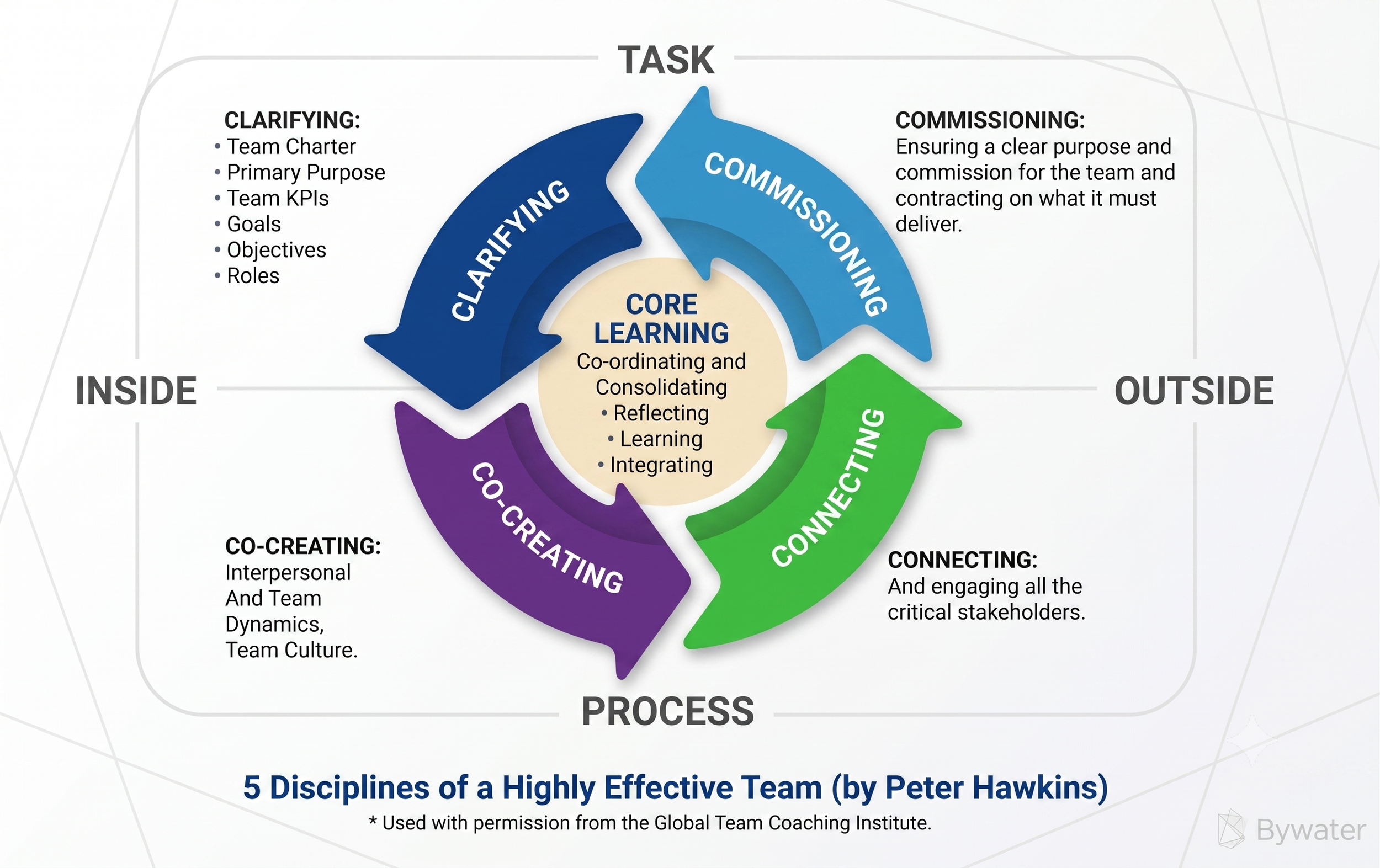
In Peter Hawkins’ 5 Disciplines model, the third discipline is Co-creating. This discipline addresses how a leadership team works together internally to generate value that no single function or department can deliver in isolation.
The Hawkins model functions as a dynamic system rather than a linear checklist. Co-creation breaks down when isolated from continuous Clarifying. Without an actively reinforced shared purpose, attempting to co-create value simply devolves into extra committee meetings or superficial alignment.
High-performing teams recognise that real joint work is separate from keeping the peace. It relies on creating the right conditions where leaders can engage in healthier challenge, trade off functional resources, and make collective decisions that support sustained progress.
Practical Application: Turning Co-Creation into Enterprise Value
Here are four evidence-informed steps to build genuine joint working across leadership roles:
Link collaboration directly to live purpose before establishing cross-functional project groups, verifying that the task strictly requires collective leadership rather than single-department execution.
Identify where departmental boundaries and resource allocations intersect to establish explicit rules for managing trade-offs when functional priorities conflict.
Reframe room tension as organisational discipline by treating constructive disagreement over strategic trade-offs as an essential component of clearer thinking and effective operational governance.
Review individual performance indicators to ensure departmental targets do not inadvertently penalise leaders for deploying resources toward collective business goals.
The ‘Better Thinking’ Question
Is your leadership team generating joint value across departmental boundaries, or are you maintaining a comfortable agreement to stay out of each other's way?
Work with Bywater
Moving a leadership team past surface politeness and into genuine co-creation requires structure, honesty, and clear direction. I work with leaders, senior teams, and HR directors across the UK to help teams clarify their collective priorities, resolve structural friction, and build the right conditions for progress that holds.