
Why ‘getting along’ isn’t enough for leadership teams.
“David, we’ve had a few leadership shake-ups recently and the team is relatively new. We have our quarterly strategy away day booked for next Tuesday, and we’d love to slot in a two-hour session for the team to connect and get to know each other a bit better. Can you run something for us?”
In my role as an Executive Team Coach within a large financial institution, this was a fairly common request. And when I say fairly common, I mean VERY common. It is also completely unstrategic. Often it felt as though the agenda was being built like a game of Tetris things being slotted in neatly to fill the time available. Often the two hours would on the day be reduced to 90 minutes (at least once it was reduced to 30 minutes!). The content request is typically something “fun”…
As I grew longer in the tooth (and lesser of hair on my head) my response to such requests became a bit disruptive: “If you want to just connect and get to know each other, cancel the coaching and go out for a great meal and a decent bottle of wine instead. It’s cheaper and a lot more fun”.
If a restaurant booking accomplishes your entire goal, you aren't actually developing a leadership team. You are just organising a social event.
There is a big difference between a group of leaders who get along well and an executive team that creates genuine corporate impact. When we confuse the two, we run straight into the Camaraderie Trap.
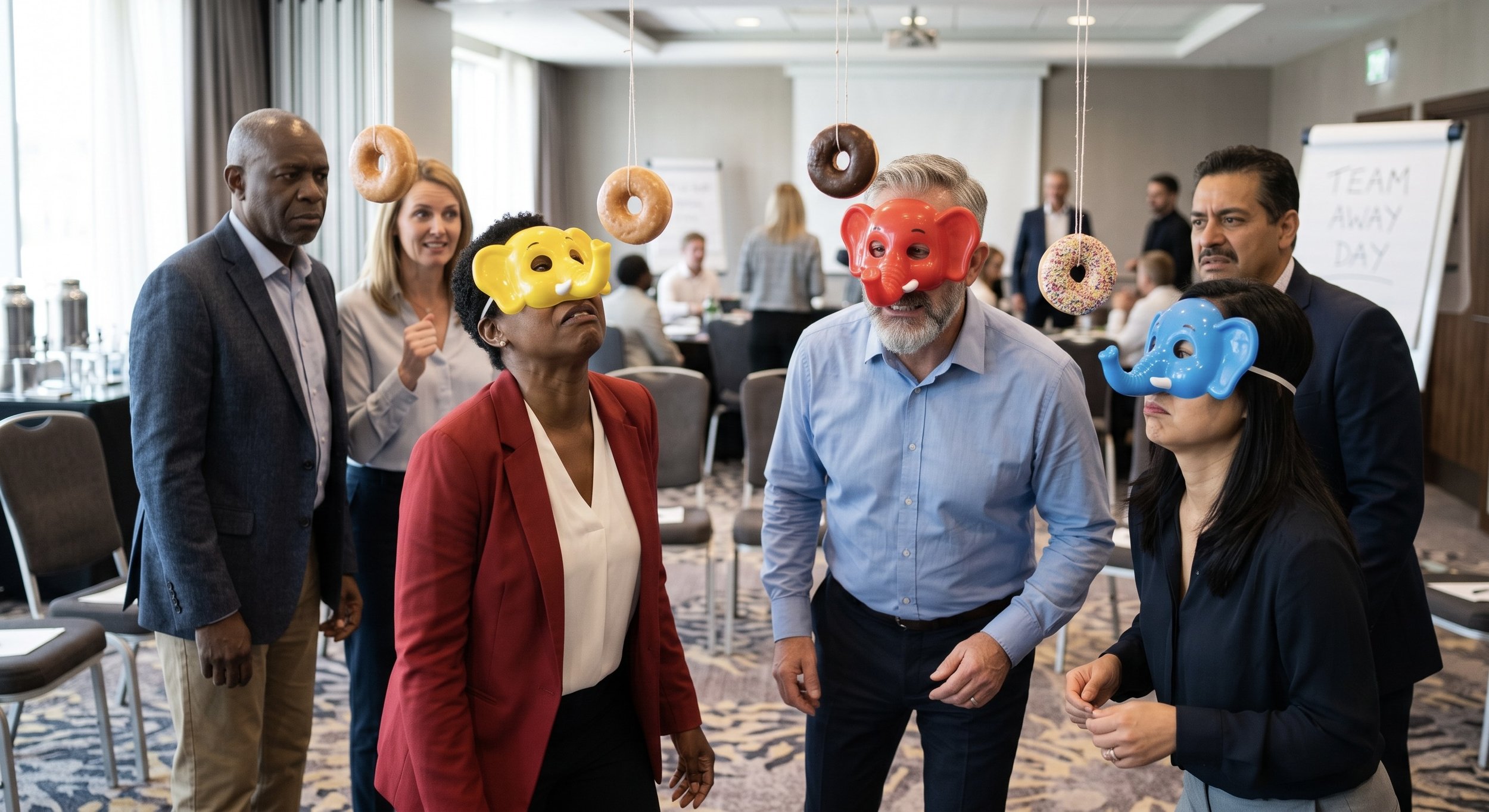
The corporate leadership right of initiation. The “fun” team building game. The belief that a team will improve their performance after embarrassing themselves in front of each other. Often with a nuclear arms race approach of each quarterly offsite demanding something more ridiculous than the last…
The ‘Real Work’ Delusion
Why do leaders relegate team development to a "slot-in" exercise on an existing agenda? Because deep down, many corporate cultures don't view working on the team as real work.
Real work is perceived as managing budgets, signing off decks, or hitting operational targets. Team development gets treated like an intermission from the day job, something soft to do when the real pressure slows down.
The reality is that the way an executive team functions dictates how everything else runs. When a leadership team operates as a collection of individual leaders rather than a cohesive unit, the business slows down. Decisions stall and departments end up working in functional silos. Aligning the leadership team directly drives business delivery; it isn't a distraction from it. But it’s difficult to measure in the moment or the immediate future. Team Development is a long game. Like the farmer who sows his crops in winter, we may not see the return immediately, but the quality of the harvest depends on the care, patience and conditions created long before anything breaks the surface. In the high paced, often frantic corporate environment the culture often demands the harvest without the requisite steps.
Connection is the Foundation, Not the Finish Line
Human connection does matter. Corporate leadership is highly pressured and can be lonely. Having peers who understand that burden and support you helps teams handle institutional stress. Having the trust that the person sitting opposite you “has your back” is incredibly valuable.
But connection is just the starting point. A leadership team can get along perfectly at dinner and still fail to deliver strategic value.
Camaraderie happens naturally when a team works well together. It shouldn't be the goal itself. High-performing teams focus on solving hard problems, and they build trust along the way. Not the other way around.
The Psychological Safety Fallacy
Many teams mistake psychological safety for niceness and comfort. They create an unspoken pact of artificial harmony: “I won’t challenge you, if you don’t challenge me.” Polite teams protect individual comfort, which stalls progress. High-performing teams use their trust to have uncomfortable, necessary debates.
Psychological safety means you have enough trust to disagree sharply on business issues without making it personal. It isn't about keeping everyone comfortable. When a team is stuck in the camaraderie trap, people become too polite. They nod along in meetings to keep the peace, then pick the decisions apart in private conversations in the corridor afterwards, or simply continue as if the meeting hadn’t even happened.
Moving Beyond Comfort: The 5 Disciplines
To transition from a group of successful individuals who "get along" to an integrated team that creates distinct organisational value, we need a framework that treats team dynamics with the same rigour as financial auditing. To date, I haven’t found a better framework than Professor Peter Hawkins’ 5 Disciplines model. It is a practical framework that moves the focus from how a team feels to what they actually achieve.
Over the next few weeks, I will write about each of Hawkins’ 5 Disciplines in turn, how I often see it show up in my experience and some quick wins that you can apply today to improve your teams effectiveness.
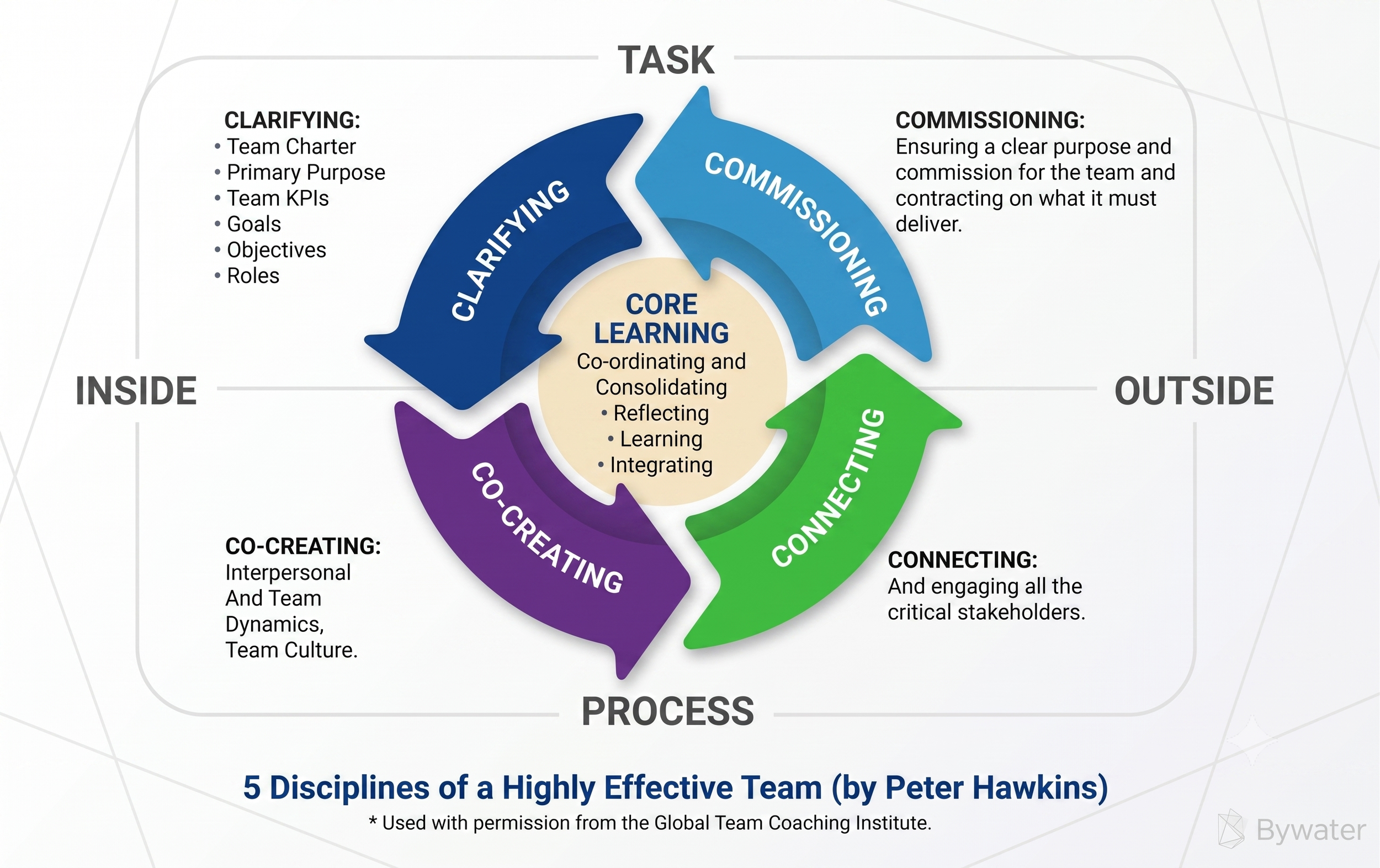
We will look at five core areas:
Commissioning: Securing a clear mandate from the wider organisation.
Clarifying: Defining a collective purpose that no single leader can achieve alone.
Co-creating: Solving complex problems together in the room.
Connecting: Engaging with the wider organisation and key stakeholders.
Core Learning: Taking regular time out to review how you work.
Next Up: The Right to Exist
If we are going to treat team development as a serious business discipline, we have to start at the beginning.
In the next post, we will look at Commissioning. It starts with a simple but difficult question that every executive team must answer: Who gives us the right to exist as a team, and what do they need from us right now?
The ‘Better Thinking’ Question
Look at the agenda for your last executive meeting or away day. Was it designed to maintain internal comfort, or was it built to confront a systemic challenge that no single director could solve alone?
Work with Bywater
Moving an executive team past artificial harmony and into genuine, high-value collective performance requires a rigorous, disciplined approach. I work with senior executives, boards, and HR leaders across the UK to diagnose team friction, break through functional silos, and turn leadership dynamics into a measurable engine for sustained progress.