
Beyond the Ceremony
How often does a scheduled retrospective get pushed back in your diary, again and again, until it simply disappears because too much time has passed? Or when the session actually happens, how often does it feel like going through the motions?
How often do you, as a leadership team, regularly reflect on how you work together in the moment while the work is happening, rather than treating reflection as a separate, isolated calendar entry?
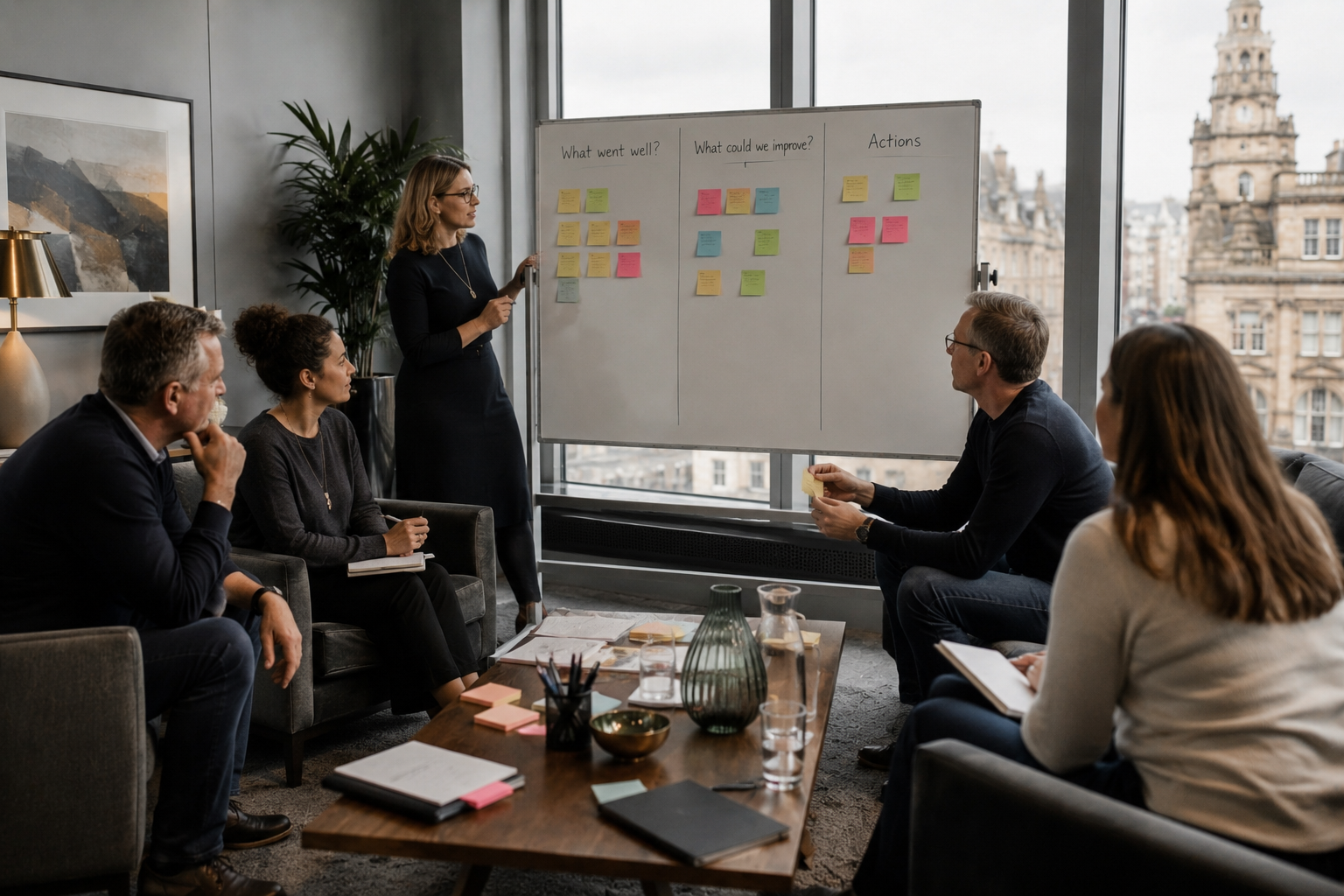
Over the past decade, the widespread adoption of Agile methods brought the retrospective into everyday corporate routines. While this shift productionised the idea of looking back, it frequently hollowed out its substance. In practice, retrospectives often become mechanical exercises. Teams gather to fill digital whiteboards, list minor process tweaks, and move swiftly on to the next backlog.
Because operational finish lines are rarely clean, deeper questions regarding leadership habits, communication bottlenecks, and working relationships are glossed over. Teams fall into a pattern of faster doing without achieving clearer thinking, repeating the same structural friction quarter after quarter.
The Bywater Insight
In Peter Hawkins’ 5 Disciplines framework, the fifth discipline is Core Learning. This discipline focuses on how a team steps back to evaluate its operational performance and adapt its working relationships in real time.
Core Learning operates as the fulcrum of the entire 5 Disciplines framework. Without continuous reflection, initial commissioning fades into vague mandates, clarifying becomes a static charter on a shelf, co-creation descends into comfortable non-aggression pacts, and stakeholder connection drifts into silence. Core Learning is the mechanism that turns those four areas from one-off exercises into live, evolving operating practices.
High-performing leadership teams recognise that reflection requires creating the right conditions for open, honest review rather than following a rigid template. By using Core Learning as a fulcrum to continually test their choices, teams encourage healthier challenge, refine their internal dynamics, and secure progress that holds.
Practical Application: Moving Beyond Ceremony to Real Reflection
Here are four evidence-informed steps to integrate Core Learning into daily operational rhythms:
Move past mechanical retrospective templates by focusing reflection on decision-making habits and working relationships rather than administrative tasks.
Embed five-minute reflective reviews into existing weekly management meetings so learning happens continuously while context remains fresh.
Treat operational missteps as collective data points rather than individual failures, focusing effort on improving underlying team governance.
Translate reflective insights immediately into live working agreements that adjust how the team manages workloads and handles strategic trade-offs.
The ‘Better Thinking’ Question
Has your team's approach to reflection become a productionised routine, or are you creating the right conditions for honest conversations about how you work together in the moment?
Work with Bywater
Moving a leadership team past constant firefighting and into continuous improvement requires structure, honesty, and clear direction. I work with leaders, senior teams, and HR directors across the UK to help teams clarify their collective priorities, resolve structural friction, and build the right conditions for sustained progress.